
How to Search Criminal Dockets
Dallas County builds no free criminal docket search of its own. Online lookup runs through the Alabama Administrative Office of Courts instead. Just One Look sells searches by name or case number. Paid subscribers can use AlaCourt. Both display trial-court case details along with authorized images. AlaFile exists for registered filers, not for public name searches.
Know the full case number? Start there. Without it, gather the exact party name. Collect spelling variants, the rough year, the court level, and the case type. A name match alone proves little. Before you read the event list, confirm Dallas County. Then check the criminal division, the filing date, and the case status.
- Identify Circuit, District, or municipal court from the notice, case number, or charge source.
- Choose a case-number or name search in Just One Look or AlaCourt and narrow the results to Dallas County.
- Open the case header and check the court, filing date, case type, status, and assigned judge.
- Read charges, settings, motions, orders, plea, disposition, sentence, and appeal entries in date order.
- Ask the Dallas County Circuit Clerk for the filed order or a certified copy when an event label is not enough.
Dallas County Criminal Docket Split
One Dallas County criminal docket case can live in more than one court as it moves along. Felonies belong to Dallas County Circuit Court, part of Alabama's Fourth Judicial Circuit. Dallas County District Court handles state and county misdemeanors. It also takes traffic matters and the early felony stages, including preliminary proceedings. A city court keeps its own ordinance, misdemeanor, and municipal traffic files.
The split matters for both your docket search and the office that holds the file. The Dallas County Circuit Clerk maintains Circuit and District criminal files. A municipal clerk keeps the original city case. When a municipal or District result is appealed for a trial de novo, the appeal creates a new Circuit docket. A trial de novo is a fresh trial in Circuit Court. The new case does not rewrite the lower file.
| Case level | First docket | Record keeper |
|---|---|---|
| Felony | Circuit Court, after applicable lower stages | Dallas County Circuit Clerk |
| State or county misdemeanor | District Court | Dallas County Circuit Clerk |
| City ordinance or municipal misdemeanor | Issuing municipal court | Municipal court clerk |
What a Criminal Docket Shows
Think of the criminal docket as a chronology, not the whole case file. A header ties together parties and counsel. It also gathers each charge, bond activity, events, settings, financial entries, and the disposition. A local Circuit criminal case may carry a CC label or another system case-type mark. Use the complete number exactly as it appears on the official record. Skip made-up formats and shortened citations.
Read each count on its own terms. One charge may be dismissed while another reaches judgment. The same caution applies to motions. A filing is only a request, and the later order is what states what the judge actually did.
| Header | Dallas County, court, full CC case number, filing date, status, and judge |
|---|---|
| Charge | Offense description, cited law, degree or class, count, and charge-level result |
| Bond | Amount, type, conditions, change, release, or forfeiture event where public |
| Settings | Arraignment, preliminary hearing, docket call, plea, trial, sentencing, reset, or continuance |
| Outcome | Plea, acquittal, conviction, dismissal, nolle prosequi, sentence, and appeal entries as recorded |
| Documents | Images offered by the paid access tier, with restricted material withheld |
Dallas County Criminal Docket Outcomes
A charge line records an accusation, nothing more. It does not prove guilt. It should never be reported as a conviction. Keep moving through the Dallas County criminal docket until the disposition for that count appears. The result may read conviction or judgment. It may read dismissal, nolle prosequi, acquittal, or another exact phrase the court uses.
Nolle prosequi means the prosecution ended that charge as stated in the record. It is not a synonym for every kind of dismissal. Bond and fine entries answer different questions too. Bond is about release security. Court costs, fines, assessments, and restitution show up after other case events. When a brief event title leaves doubt, read the signed order.
- Setting
- A scheduled court event, not an outcome.
- Plea
- The defendant's formal response to a charge.
- Disposition
- The recorded result for a charge or the case.
- Continuance
- An order moving a setting to a later date.
Stages on a Criminal Docket
A Dallas County felony docket usually opens in District Court. Expect entries for a complaint, a warrant, a bond event, and an initial appearance. These come before the preliminary stage. An indictment moves things along. If a grand jury charges the case, the record shifts toward arraignment in Circuit Court. The criminal docket picks up speed from there. Discovery, motions, and pretrial settings fill the middle of the timeline. A plea or a trial comes next, then judgment and sentence. Post-judgment motions and an appeal can still follow.
Docket flow: Filing › Arraignment › Pretrial › Plea or Trial › Disposition › Sentencing
Do not assume the path runs straight. A reset keeps the old date in the chronology and adds a new one, so the sequence can double back on itself. Plea and sentencing may land on different dates. Even the last line of the trial docket can mislead, because a notice of appeal opens a fresh appellate record and the case lives on.
Dallas County Criminal Docket Resets
Treat the newest date in a Dallas County criminal docket as a clue. It is not an answer. Read the newest written or electronic notice first. Then scan later docket entries for words like "continued," "reset," "cancelled," "order," or a disposition. The assigned judge controls the calendar; the clerk records each notice and event.
Conflicting entries call for a phone call. Reach the Dallas County Circuit Clerk at 334-874-2523. Or contact the office named on the notice itself. Circuit judge offices publish 334-874-2510 and 334-874-2507. The District judge office lists 334-874-2529. Confirm the setting stands, ask what type it is, and find out where to report.
Current-setting check: A docket call tests case status and readiness. It is not necessarily the trial itself.
Which Court Holds Criminal Dockets
The Dallas County Fourth Judicial Circuit site is the main local entry point. It opens the door to court records. One clerk serves both levels. The Circuit Clerk holds the records of Dallas County Circuit Court and Dallas County District Court alike. That arrangement does not pull municipal files into the county criminal docket. Whatever paper started your case, a citation, summons, or notice, check which court is printed on it and begin there.
For a Circuit criminal setting, the official Circuit judge page shows which office handles the matter. The docket and the current order still control the details.
Dallas County Criminal Docket Documents
A docket line is only an index entry. It tells you a motion, order, or judgment was filed, but not what the paper says. Paid AlaCourt access can sometimes show document images, where the access tier and court rules allow. Even that image is not a certified copy.
Need the actual text? Write down the event date and title, then ask the Circuit Clerk for the document. Open files can be reviewed at the clerk-controlled counter under Rule 30. Copies and certification cost extra. Mail precise requests to P.O. Box 1148, Selma, AL 36702-1148, and call ahead for the current price and availability. A wider lookup workflow is laid out in the Dallas County case search.
Dallas County Criminal Docket Expungement
Expungement is a court process. It is not a delete button inside AlaCourt. Dallas County publishes filing instructions and charges a $300 filing fee. Eligibility turns on Alabama law and the facts of the case. The petition goes to the Dallas County Circuit Clerk. A judge must act on it. The Dallas County expungement instructions show the local manifest image.
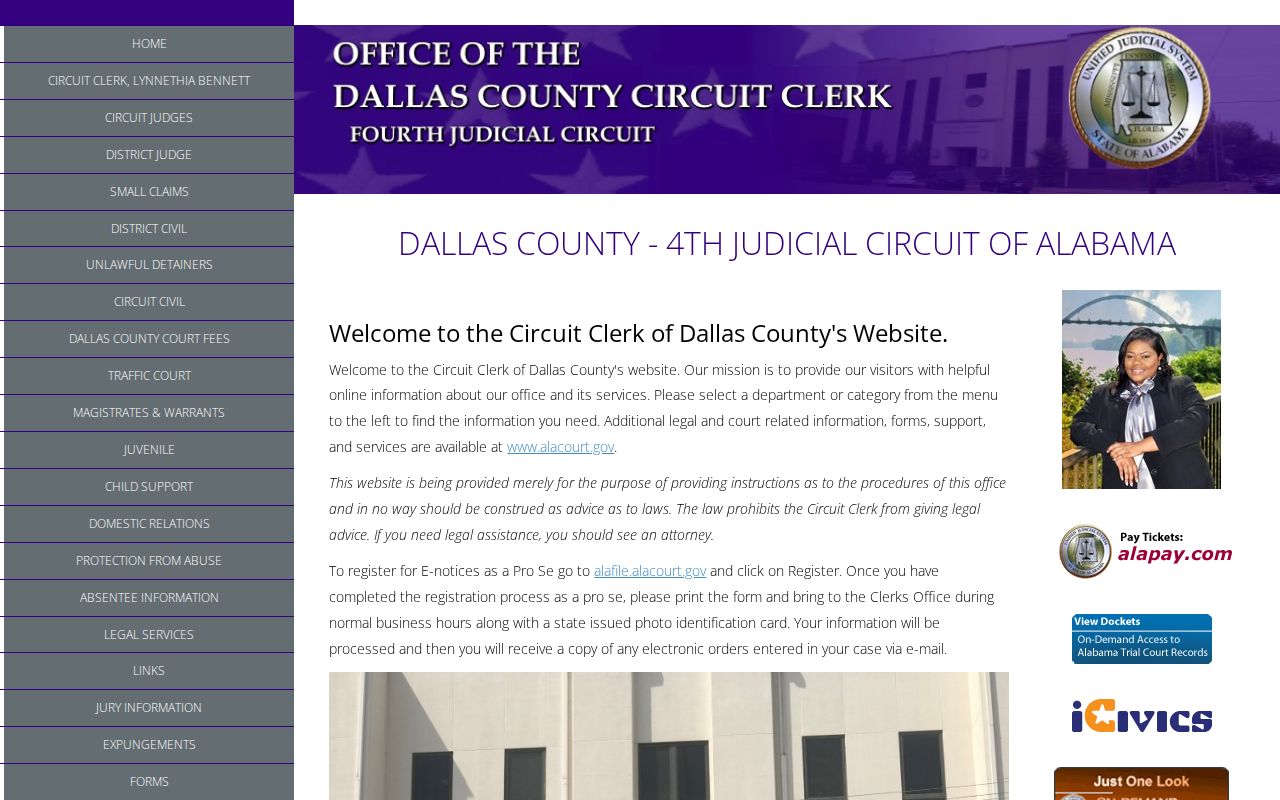
That procedure stands apart from portal support. Only the court can decide the petition, and restricted records may stay unavailable while the case is pending.
Dallas County Criminal Docket Transfers
A felony can leave tracks in two courts. Early events sit in District Court, later ones in Circuit Court, so check both stages. The District preliminary hearing tests probable cause; it is not the Circuit trial. An indictment and a Circuit case number may exist soon. Once they do, the Circuit criminal docket carries arraignment, later motions, plea or trial, disposition, and sentence.
Appeals split records too. A municipal or District appeal heard de novo in Circuit Court gets its own Circuit docket. It also gets its own number. Watch for notice of appeal, record transmitted, transfer, assignment, and new setting entries. The lower docket still matters, since it shows how the case reached Circuit Court.
Dallas County Juvenile Docket Access
Juvenile records never take the ordinary public name-search path. Alabama Code § 12-15-133 makes juvenile legal, social, and medical records confidential. They are open only to authorized people and statutory disclosures. Dallas County steers juvenile record questions to 334-874-2528.
Missing a juvenile matter in public case details proves nothing about whether a proceeding exists. An authorized party should use the juvenile channel. Bring identification plus proof of authority if asked. Clerk staff cannot release protected content or hand out legal advice.
Dallas County Criminal Docket Keeper
The Dallas County Circuit Clerk keeps records for seven courts, per the official clerk profile. That duty spans criminal, civil, domestic, child-support, and juvenile divisions. Yet the access limits between them still stand. Clerk Lynnethia Bennett's office receives filings and indexes events. It issues process and notices, preserves files, takes court-ordered funds, and certifies copies.
The clerk records what the judge orders. The judge sets the calendar and rules on a motion. A court reporter, not the clerk, makes the word-for-word record of a hearing. A Dallas County criminal docket, a signed order, and a transcript each come through a different channel.
Public Access and Sealed Criminal Dockets
Open Dallas County criminal court files can be inspected free at the Circuit Clerk's counter. Public hours run 8:00 a.m. to noon and 1:00 to 4:30 p.m., Monday through Friday. The counter is closed to the public every Wednesday. Phone and mail help confirm the file, copy price, and archive status before you drive over.
Remote access can be narrower. Sealed cases, expunged material, protected identifiers, juvenile records, adoption material, and other confidential content may be withheld, redacted, or left out. The official Code of Alabama source supplied the final criminal manifest image.
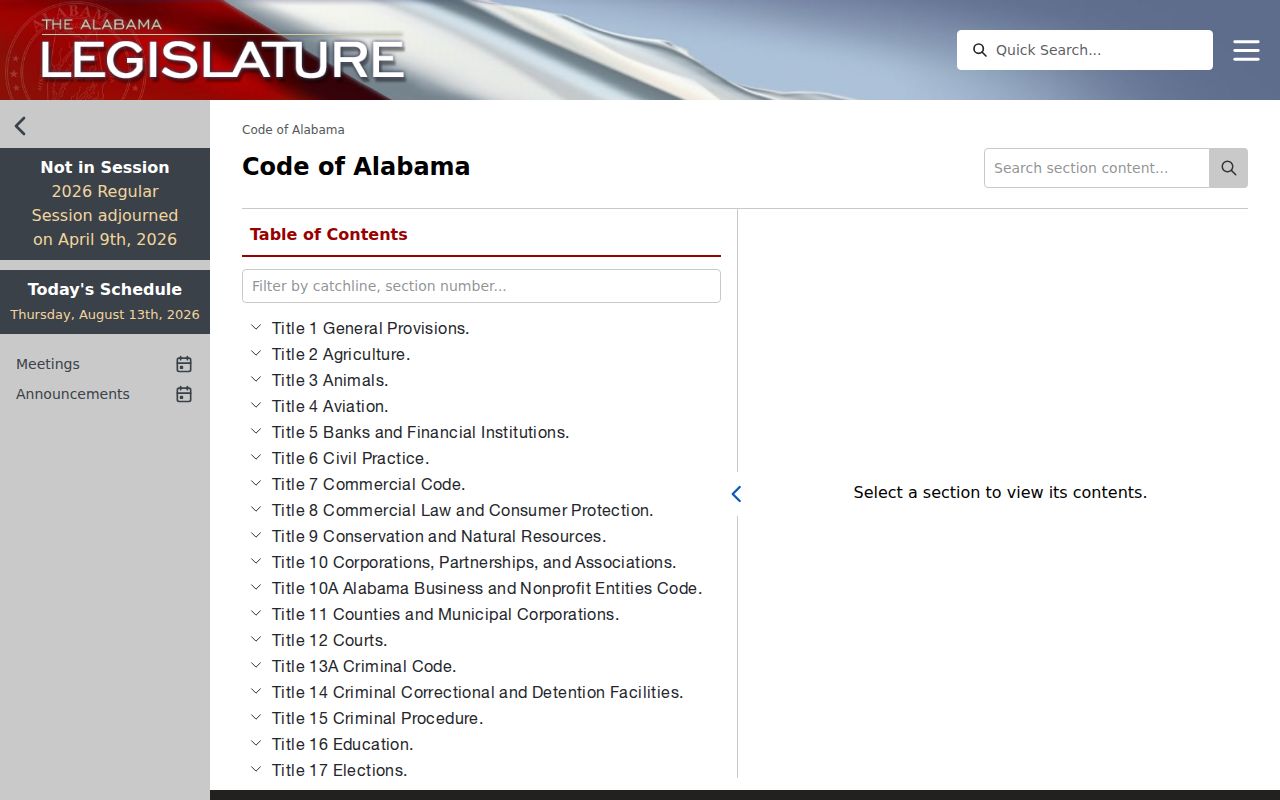
The law source helps spot the governing statutes. Still, the clerk and a court order decide what any specific Dallas County criminal docket can release.
Key Rules:
Alabama Rule of Judicial Administration 30 keeps open court files available for free inspection while protecting sealed and restricted files.
Alabama Rule of Judicial Administration 33 governs AOC electronic data and image access through authorized services.
Alabama Court-Record Privacy Rules set public-access limits and protect specified private information.